All prisons
All in France →
France · Drancy
Drancy concentration camp
Concentration campHigh
Verified
Aging · 3mo ago
Sources last reviewed on
Data is aggregated from public sources and may be incomplete or out of date. Always verify with primary sources before acting on any figure. See data sources.
For families
How to send mail, money, and visit Drancy concentration camp
Step-by-step guidance using the France system — addresses, money services, visit booking, what to bring on your first visit.
Gallery
From Wikimedia Commons (CC-BY-SA where not otherwise stated).

Photo by Jacques Gotko via Wikimedia Commons (CC BY 3.0)

Photo by Begelmir via Wikimedia Commons (CC BY-SA 3.0)

Photo by Wisch via Wikimedia Commons (CC BY-SA 3.0 de)
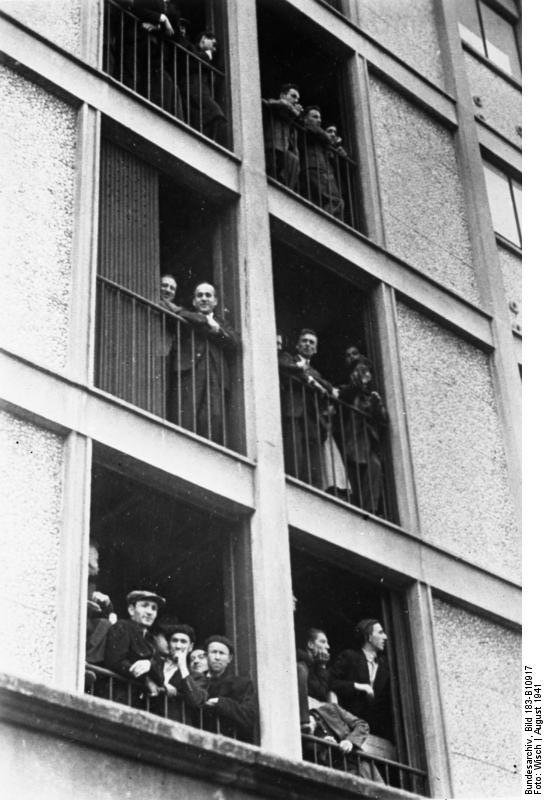
Photo by Wisch via Wikimedia Commons (CC BY-SA 3.0 de)

Photo by Wisch via Wikimedia Commons (CC BY-SA 3.0 de)

Photo by Wisch via Wikimedia Commons (CC BY-SA 3.0 de)

Photo by UnknownUnknown via Wikimedia Commons (CC BY-SA 3.0 de)

Photo by UnknownUnknown via Wikimedia Commons (CC BY-SA 3.0 de)
Background
Drancy internment camp (French: Camp d'internement de Drancy) was an assembly and detention camp for confining Jews who were later deported to the extermination camps during the German occupation of France during World War II. Originally conceived and built as a modernist urban community under the name La Cité de la Muette (lit.â'The City of the Mute'), it was located in Drancy, a northeastern suburb of Paris, France. Between 22 June 1942 and 31 July 1944, during its use as an internment camp, 67,400 French, Polish, and German Jews were deported from the camp in 64 rail operations, which included 6,000 children. Only 1,542 prisoners remained alive at the camp when the German authorities in Drancy fled as Allied forces advanced and the Swedish Consul-General Raoul Nordling took control of the camp on 17 August 1944, before handing it over to the French Red Cross to care for the survivors. Drancy was under the control of the French police until 1943 when administration was taken over by the SS, which placed officer Alois Brunner in charge of the camp. In 2001, Brunner's case was brought before a French court by Nazi hunter Serge Klarsfeld, which sentenced Brunner in absentia to a life sentence for crimes against humanity.
Source: Wikipedia article lead, CC-BY-SA.
Capacity
—
Current population
—
Occupancy
—
Year opened
—
Operational
Figures from official sources · verified 16 Jun 2026 · methodology
Facility profile
Operator
—
Population held
Mixed/unknown
Opened
—
Region
Drancy
Security level
—
Death-row facility
No
Conditions
No conditions summary available yet.
Visiting
No visiting information available.
Mailing
No mailing information available.
Practical info
Contact the operator's website for inmate-specific procedures.
Known issues
No major issues documented in our database.
Notable inmates
- Albert Vogel1883
- Meir Zauberman1901–1941
- Edwin Heimann1899–1944
- Nachim Sperling1898–1941
- Simon Badinter1895–1943 · furrier
- Hélène Metzger1889–1944 · philosopher
Hélène Metzger (26 August 1889 â 7 March 1944) was a French philosopher of science and historian of science.
- Gilbert Makowski1940–1944
- Hilde Schmiedl1884
Showing 9 of 12. Source: Wikidata + Wikipedia.
Contact & address
Conditions Risk Score
Derived signal — not a judgement. How it's calculated
—
Insufficient data
We don't have enough public data on this facility to score it. Have something to add? Send us a correction.
Related facilities
Same country, matched on type + security level where possible.
- Montech concentration campConcentration camp
- Château du Roc concentration campConcentration camp
- Prémol concentration campConcentration camp
- Chabanet concentration campConcentration camp
- Oberehnheim concentration campConcentration camp
- Château de Bégué concentration campConcentration camp
Data completeness
28%How many of our profile fields are populated. We surface this so families and researchers know the limits.
Sources
- EHRI Authority Record
- Wikidata entity
- Wikipedia — Wikimedia Foundation
- Wikidata — Wikimedia Foundation
- EHRI Authority List of Camps and Ghettos / USHMM Encyclopedia of Camps and Ghettos — European Holocaust Research Infrastructure (EHRI) / United States Holocaust Memorial Museum (USHMM)
- Wikidata (Q247958)
- Wikipedia
- Wikimedia Commons
- See /data-sources for our overall methodology.
Cite this page
Under CC-BY-4.0. Include the URL and access date; the site is a living reference and entries can change.
APA
World Prisons. (2026). Drancy concentration camp. Retrieved September 19, 2026, from https://worldprisons.com/prisons/drancy-concentration-camp
Chicago
"Drancy concentration camp." World Prisons. Accessed September 19, 2026. https://worldprisons.com/prisons/drancy-concentration-camp.
BibTeX
@misc{worldprisons-drancy-concentration-camp,
  author = {{World Prisons}},
  title = {Drancy concentration camp},
  year = {2026},
  url = {https://worldprisons.com/prisons/drancy-concentration-camp},
  urldate = {2026-09-19}
}