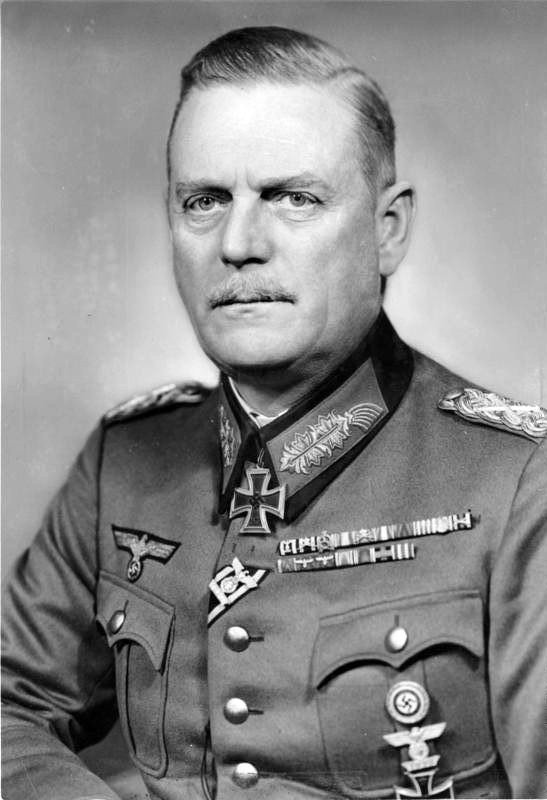
Wilhelm Keitel
1882–1946
- Nationality
- Germany
- Occupation
- politician
Wilhelm Bodewin Johann Gustav Keitel (German pronunciation: [ËvɪlhÉlm ËkaɪtlÌ©]; 22 September 1882 â 16 October 1946) was a German field marshal who held office as chief of the Oberkommando der Wehrmacht (OKW), the high command of Nazi Germany's armed forces, during World War II.
Incarceration history
Facilities
- Camp KingDates unknown
- Nuremberg Court PrisonDates unknown
Biography
Wilhelm Bodewin Johann Gustav Keitel (German pronunciation: [ËvɪlhÉlm ËkaɪtlÌ©]; 22 September 1882 â 16 October 1946) was a German field marshal who held office as chief of the Oberkommando der Wehrmacht (OKW), the high command of Nazi Germany's armed forces, during World War II. He signed a number of criminal orders and directives that led to numerous war crimes. Keitel's rise to the Wehrmacht high command began with his appointment as the head of the Armed Forces Office at the Reich Ministry of War in 1935. Having taken command of the Wehrmacht in 1938, Adolf Hitler replaced the ministry with the OKW and Keitel became its chief. He was reviled among his military colleagues as Hitler's habitual "yes-man". After the war, Keitel was indicted by the International Military Tribunal in Nuremberg as one of the "major war criminals". He was found guilty on all counts of the indictment: crimes against humanity, crimes against peace, criminal conspiracy, and war crimes. He was sentenced to death and executed in Nuremberg by hanging in 1946.
Related people
Same nationality and era where possible; falls back to shared nationality or era.
- Viktoria Hösl1902–1953Germany
- Erna Gersinski1896–1964Germany
 Siegfried Westphal1902–1982Germany
 Constantin von Dietze1891–1973Germany
Friedrich Carl Nicolaus Constantin von Dietze (9 August 1891 â 18 March 1973) was an agronomist, lawyer, economist, and theologian.
- Julius Baruch1892–1945Germany
 Joachim Mrugowsky1905–1948Germany
Joachim Mrugowsky (15 August 1905 â 2 June 1948) was a Nazi bacteriologist who committed medical atrocities at the Sachsenhausen concentration camp.